It Wasn’t Manufactured Correctly.
Usually, It Was — the Field Pattern Jakob Keeps Finding Instead
Specifying Cable Mesh: What ARCAT’s Detailed Podcast Revealed About Field Failures and Spec Sequencing
Picture the moment a project goes sideways. Not at the concept stage, and not on the day the crew shows up. It happens somewhere in the middle — the spec is written, the bid is closed, the shop drawings are in review, and someone finally asks the manufacturer a question that should have been asked eleven months earlier.
That moment is what Heshan Rankothgedera, Sales and Project Management at Jakob Rope Systems, was asked about on the expo floor at the AIA Conference on Architecture & Design in San Diego. His host was Cherise Lakeside — a CSI Fellow and senior spec writer who does this work for a living — recording for Detailed, the original podcast by ARCAT.
Her question was blunt: if you could sit a room full of spec writers down and make their lives easier, what would you tell them?
“The key word is communication”
Heshan’s answer took one word, and he came back to it three times over seventeen minutes.
Call before you write. Not after.
The reasoning is about sequencing, not sales. Stainless steel cable and mesh systems cover an unusually wide range of applications — a simple guardrail, a green wall, safety netting, an animal enclosure. The right product for one is the wrong product for another, and the difference is often invisible in a two-line spec section.
“Once we get an idea of what your train of thought is, then we can tell you: here’s what you need to use,” Heshan said. “That way, once it’s actually written into the spec, it’s a done deal.”
The alternative isn’t catastrophe — it’s friction. Jakob can still make the correct recommendation after the fact, once the full scope is visible. But by then the project has moved through bidding and into construction, and correcting a specification means change orders, requalification, and production lead times that nobody budgeted for.
Lakeside, who also teaches in the industry, framed it with a curve her students know well: the cost of a decision climbs steeply the later it gets made. Her version was sharper than any manufacturer would put it — do you really have time to deal with all the problems you’re going to have in construction, because you couldn’t make a ten-minute phone call?
What actually goes wrong in the field
The second half of the conversation moved from the spec to the site, and the pattern Heshan described will be familiar to anyone who has run a punch list.
The call comes in. The product doesn’t fit, doesn’t align, doesn’t look like the drawing. The opening line is almost always some version of this wasn’t manufactured correctly.
“When we really sit down and look at it, it’s just that,” he said — a step that got skipped. Not a defect.
The cause is the same pressure that produces every other field problem: schedule. Installers are working against a deadline, so the installation sequence gets compressed and a step that looked optional gets dropped. It rarely looks like a mistake until two runs later, when nothing lines up.
Jakob ships installation drawings with its systems, and in many cases installation videos and general guidelines as well — all available in the resources library. The material exists. The recurring issue is that it goes unread by the person holding the tools.
For specifiers, that suggests a practical move: reference the manufacturer’s installation documentation directly in the spec, and make the pre-installation meeting a submittal requirement rather than a courtesy. Our specifying guide covers the language.
What’s new: modular goes vertical
Asked what he’d want a spec writer to go look at, Heshan made a case against the default.
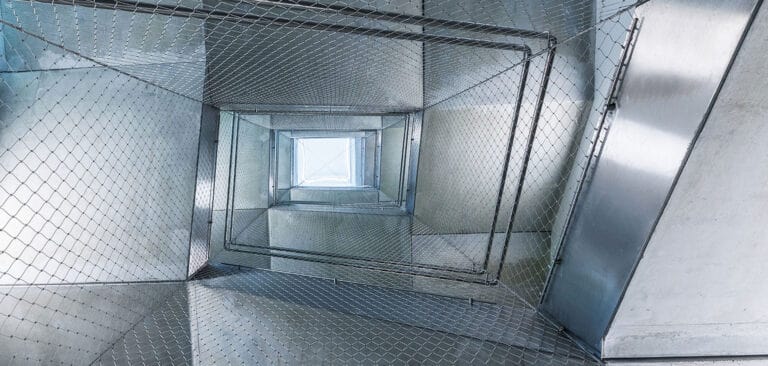
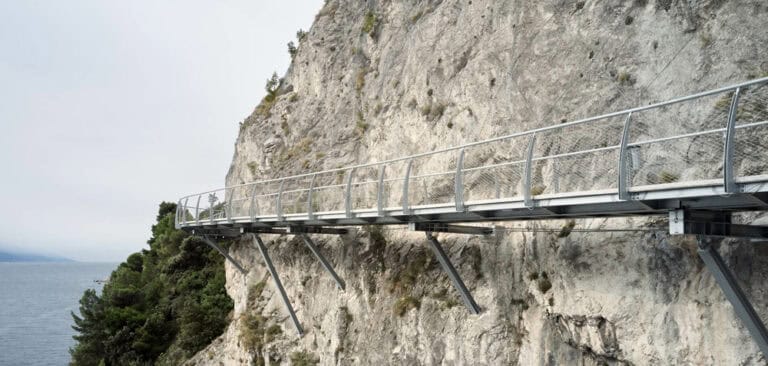
The ordinary horizontal cable guardrail, in his words, is old. Wire mesh does the same structural job with far more transparency — it reads as a surface you look through rather than a set of lines you look past, which matters on a bridge deck, a stadium concourse, or any elevation where the view is the point.
The system behind that argument is Jakob’s modular frame line. Frames arrive at 4′ × 42″ in AISI 316 marine-grade stainless steel, with the infill already installed and pre-tensioned at the factory. Two options: Webnet diamond mesh at 1.5 mm rope diameter, or vertical cables at 3 mm. Both are code-compliant as delivered.
The sequence on site is the part that matters for the failures described above. Set the posts, then insert the frames — no welding, no specialized tools, and no on-site tensioning. The step most likely to get rushed is the one that no longer happens in the field.
Three frame profiles (round tube with Webnet, square tube with Webnet, square tube with cables) share identical mounting hardware, so they can be mixed across a project without changing the installation method. Three mounting types — top mount, core drill and fascia — use that same hardware, and continuous-run connectors carry the system through curves, stair angles and long straight runs.
Why Jakob
Jakob Rope Systems has been manufacturing cable since 1904, from a head office in Switzerland and a dedicated mesh production facility in Vietnam — the two ends of a supply chain the company owns rather than brokers.
In the United States, projects are handled directly by the team in Lake Worth Beach, Florida, roughly forty minutes north of Fort Lauderdale. That team combines sales, project management and design assistance, which is what makes the ten-minute call Heshan keeps recommending an actual option rather than a routing exercise: the person who picks up is the person who will see the project through.
It also explains the range. Architectural ropes, Webnet mesh, modular frames and green façade systems come from one manufacturer, on one set of drawings, with one point of contact — instead of three suppliers and an interface detail nobody owns.
Start the conversation at step one
If you have a project where cable or mesh is on the table — or a spec section you would rather get right the first time — that is exactly the call Heshan was describing.
Contact our team to talk through the application before the language is locked.